
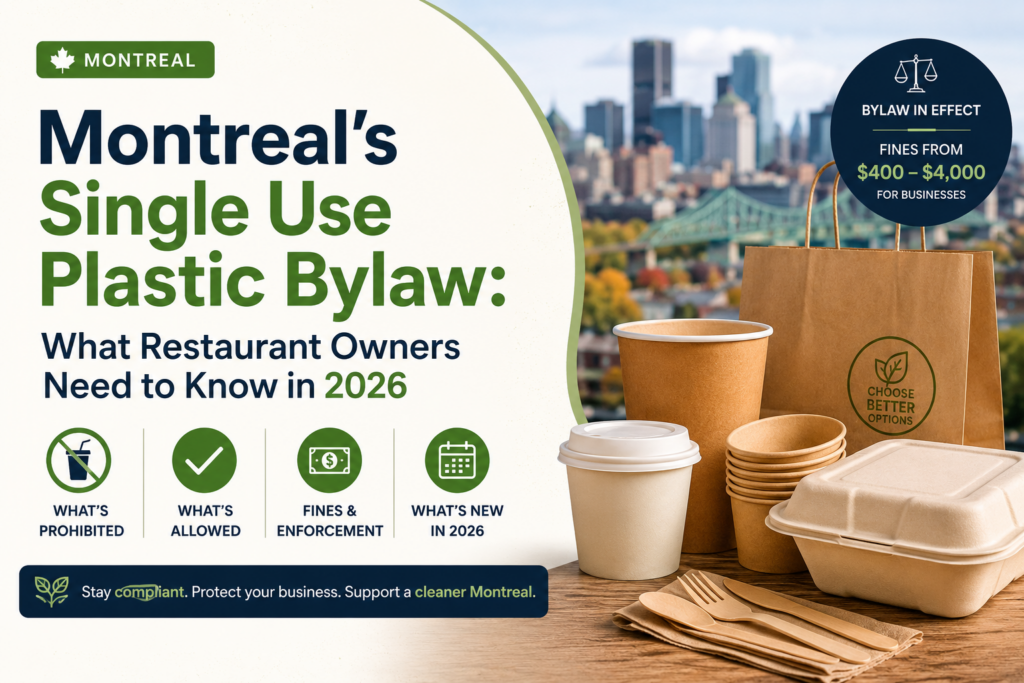
If you run a restaurant, café, food truck, or grocery counter in Montreal, you have probably already swapped your plastic cups for something else. But three years in, a lot of owners are still unsure exactly what is and is not allowed, what the fines actually look like, and whether anything has changed heading into 2026. It has, and it is worth a fresh look.
Here is a clear, current breakdown of the bylaw, straight from the City of Montreal and the Government of Canada, so you can keep your business compliant without guessing.
The Bylaw Is Not New, But It Is Still Very Much Active
Montreal’s single use plastic bylaw came into force on March 28, 2023, following an earlier ban on lightweight plastic shopping bags. According to the City of Montreal, the rule prohibits the distribution of several single use plastic items in the city’s restaurants and food businesses, whether the food is eaten on site, ordered for takeout, or delivered.
The city defines a single use plastic item as one used to package or consume food, distributed individually, and meant to be used only once or for a short time before being thrown out or recycled. That definition is broad on purpose, and it is the starting point for everything else in the regulation.
What the Bylaw Actually Prohibits
The City of Montreal splits the banned items into two groups.
Group #1: Banned outright, for on site consumption, regardless of material.
Cups, glasses, stirring sticks, straws, and utensils used for eating on the premises cannot be plastic at all under this category, whether the plastic is conventional or compostable.
Group #2: Banned for takeout and delivery, when made from certain resins.
Plates, containers, lids, trays, and utensils made from polystyrene (resin number 6) cannot be distributed for takeout or delivery either. The only exception in this group is trays used for raw meat and fish.
It is worth being precise here, because this detail trips up a lot of owners. The rule is not a judgment on compostable materials as a category. It is about the resin the item is made from. Rigid PLA or PHA cups and containers fall under the same restriction as polystyrene because they are still classified as plastic resin. Fiber based products, like paperboard cups, plates, and bagasse containers, are treated differently, and many of these are compostable and recyclable at the same time. That distinction matters a great deal when you are choosing replacement packaging, and we will come back to it.
Who Has to Comply
The bylaw applies to any establishment that offers restaurant service or packages food for retail sale. The City of Montreal lists examples including restaurants, food courts, food trucks, school and employee cafeterias, vending machines, catered events, grocery store takeout counters, bakeries, butcher shops, and cheese markets. When the rule first came into effect, the city estimated roughly 8,400 businesses across its 19 boroughs would need to adjust. That number has since grown to approximately 9,500 food merchants and restaurants as the city continues tracking compliance.
What Is Still Allowed
The City outlines a short list of exceptions:
- Non profit food aid organizations, such as charities that distribute food or meals to vulnerable people
- Establishments that only offer home delivery, such as caterers who do not serve the public directly
- Food that was pre packaged outside the establishment
- Plastic coated cardboard cups, glasses, and containers, whether compostable or not
That last exception is a big one for restaurant owners planning their packaging strategy, since it confirms that coated paperboard, a common and often compostable and recyclable format, remains a compliant option.
Fines and Enforcement
The city does not fine businesses on the first visit. Municipal inspectors issue a warning initially, and fines apply from the second violation onward, ranging from $400 to $4,000 for businesses, depending on the severity and whether it is a repeat offence.
Enforcement has been steady rather than aggressive. City health inspectors, who already visit food establishments regularly, check for compliance during those routine visits, which keeps the process fairly low friction for owners who are already making the switch.
A New Development for 2026: The Federal Plastics Ban Was Just Upheld
This is the part many Montreal restaurant owners have not caught up on yet. Separate from the municipal bylaw, the Government of Canada has its own federal Single Use Plastics Prohibition Regulations, which restrict the manufacturing, importing, and selling of six categories of plastic items nationwide, including foodservice ware made from expanded or extruded polystyrene, checkout bags, stir sticks, ring carriers, straws, and cutlery.
That federal regulation faced a legal challenge questioning the government’s authority to classify plastic manufactured items as toxic under the Canadian Environmental Protection Act. On January 30, 2026, the Federal Court of Appeal confirmed that listing, which gives the federal regulation the legal footing it needs to remain in force. According to Environment and Climate Change Canada, the regulation is, in its own words, still in effect.
For a Montreal restaurant, this means two layers of regulation now apply at once: the municipal bylaw governing what you can hand to a customer in your dining room, and the federal rule governing what plastic foodservice products can legally be manufactured, imported, or sold anywhere in Canada in the first place. In practice, that federal ruling closes off any lingering hope that stricter plastic rules might quietly disappear. If anything, 2026 is the year to assume this direction is permanent and plan packaging purchases accordingly.
Choosing Compliant Packaging Without the Guesswork
Given both layers of regulation, the safest approach for Montreal restaurant owners is to move toward packaging that is not plastic resin at all. Fiber based products such as paperboard cups, bagasse clamshells, and kraft food containers sit outside the categories restricted by both the municipal bylaw and the federal regulation, and many of them are compostable and recyclable, giving you flexibility depending on your local waste stream.
At Eco2Bureau, our lineup is built around exactly this kind of packaging. Our compostable and recyclable products are designed to fit the categories Montreal’s bylaw still allows, so you can update your supply order once and stop worrying about whether next month’s shipment puts you out of compliance. You can browse the full range at Eco2Bureau.
A Simple Compliance Checklist for 2026
- Confirm that any cup, glass, stirring stick, straw, or utensil used for dine in service meets the standard
- Keep raw meat and fish trays as your only exception in that category
- Choose fiber based, plastic coated cardboard, or otherwise non resin packaging where possible
- Watch for federal level restrictions on plastic foodservice ware, checkout bags, and straws, since these apply on top of the municipal bylaw
- Document your supplier’s packaging specifications in case a city inspector asks during a routine visit
Final Thoughts
Montreal’s single use plastic bylaw is not going anywhere, and the January 2026 federal court decision makes it clear that plastic foodservice packaging is facing pressure from every level of government, not just the city. For restaurant owners, the most practical move is to standardize on packaging that already clears both sets of rules rather than reacting order by order. If you want a straightforward starting point, Eco2’s compostable and recyclable packaging is built with exactly this kind of compliance in mind. Take a look at the shop at Eco2Bureau and see what fits your menu.