if you run a restaurant, café, food truck, bakery, or other food-service business, you have probably seen the words compostable, biodegradable, and recyclable printed across packaging products.
They sound similar, but they do not mean the same thing.
Understanding the difference matters when you are choosing food packaging, talking to customers about your sustainability practices, or deciding what claims to put on your website and packaging.
It matters even more in Canada, where regulators are paying increasing attention to environmental claims and how businesses describe the environmental benefits of their products.
So, what does each term mean and what should restaurant owners look out for when buying packaging?
Compostable vs. Biodegradable vs. Recyclable!
The bast way to understand the three terms is this:
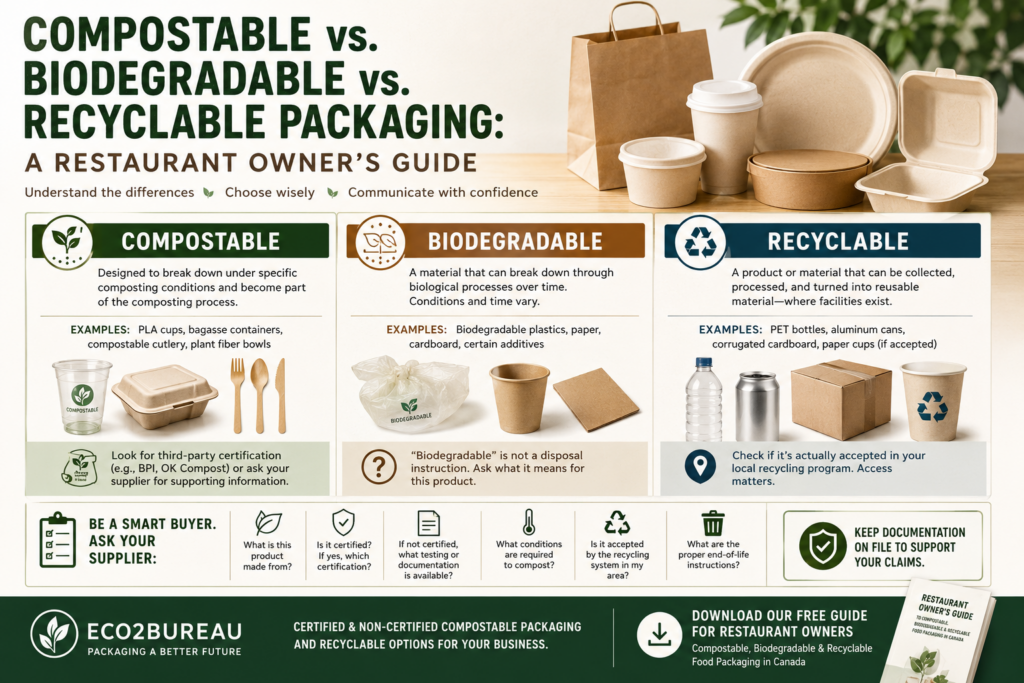
Biodegradable is describe as material’s ability to break down through biological processes.
Compostable describes a product is designed to break down under specific composting conditions and become part of the composting process.
Recyclable means a product or material that can be collected, processed, and turned into reusable material.
That last point is particularly important for restaurants. A package may technically be made from a recyclable material, but that does not necessarily mean your municipality accepts it in its recycling program.
What Does Biodegradable Mean?
Biodegradable is the broadest of the three terms.
biodegradable material can break down through the action of microorganisms over time. However, the word itself does not necessarily tell you how quickly it will break down, where it will break down, or what conditions are required. It also does not automatically mean that a product belongs in your compost bin.
For restaurant owners, the practical takeaway is simple: don’t treat “biodegradable” as a disposal instruction.
If a supplier describes packaging as biodegradable, ask what the claim means for that particular product and whether supporting information or testing is available.
Canadian regulators have also been developing more detailed rules around environmental claims on plastic packaging, including proposed restrictions around certain uses of terms such as biodegradable and degradable.
What Does Compostable Mean?
Compostable is a more specific claim. A compostable product is designed to break down under defined composting conditions without leaving unacceptable residues behind. But there is an important distinction that restaurant owners should understand:
Not every compostable product is third-party certified. Some compostable packaging carries certification from an independent organization against a recognized standard. Others are sold as compostable without third-party certification and maybe supported by manufacturer specifications, testing, material information, or documentation.
Certification provides additional level of confidence based on organization evaluation standard. However, the absence of third-party certification does not mean that a product is not compostable.
If you are considering non-certified compostable packaging, ask your supplier the following:
- What material is used in the manufacturing of the product
- Under which conditions is it designed to compost
- Any testing or technical documentation
- Is it intended for commercial or industrial composting
- Appropriate end-of-life instructions
At Eco2Bureau, we offer both certified and non-certified compostable products which gives businesses options to choose based on their purchasing priorities.
Is Compostable Packaging Recyclable?
Not necessarily. Compostable and recyclable are two different claims based on two different end-of-life pathways.
A compostable container should not automatically be placed in a recycling bin simply because it looks like conventional plastic packaging. Likewise, recyclable packaging is not automatically compostable.
The correct disposal method depends on the product and the waste-management system available where you operate.
That is why restaurant owners should always check the manufacturer’s instructions and their local waste-management requirements before deciding how packaging should be disposed of.
What Does Recyclable Mean?
Recyclable packaging can be collected and processed through a recycling system but local access matters. This is one of the biggest areas of confusion for businesses.
A material may be technically recyclable while still being rejected by the recycling program available to your customers.
Canada’s Competition Bureau has already highlighted the consequences of making recycling claims that do not reflect real-world access. And in 2022, Keurig Canada paid $3 million penalty fine because of their false claims over recyclability of its K-Cup pods.
The lesson for restaurant owners is straightforward:
Don’t assume that “recyclable” means recyclable everywhere.
Before making a recyclable claim, check whether the relevant packaging is accepted by the collection system in your area.
What Restaurant Owners Should Ask Their Packaging Supplier
Whether you are buying compostable food containers, takeaway cups, bags, plates, or other restaurant packaging, don’t rely solely on the words printed on the box.
Ask your supplier:
- What is this product made from?
- If it is described as compostable, what supports that claim?
- Is it third-party certified? If so, which certification applies?
- If it is not certified, what product specifications or testing are available?
- What conditions are required for the product to compost?
- If it is described as recyclable, is it actually accepted by the recycling system where my customers live?
Asking these questions can help you choose packaging based on information rather than assumptions.
Why This Matters in 2026
Environmental claims are receiving increasing attention in Canada.
The Competition Bureau says environmental claims must not be false or misleading and that certain environmental benefit claims need adequate and proper testing or substantiation.
Meanwhile, Environment and Climate Change Canada has proposed a more detailed framework for environmental labelling on certain plastic products, including requirements related to compostability and recyclability claims.
The proposed framework is not the same thing as saying that every proposed requirement is already mandatory. But it does signal where Canadian packaging and environmental marketing rules are heading.
For restaurant owners, the safest approach is to understand the claims attached to the products you buy and avoid making environmental claims that you cannot support.
A Simple Packaging Checklist
Before placing your next packaging order, ask yourself:
Keeping supplier documentation on file is also a smart practice, particularly if you use environmental claims in your own marketing.
Where Eco2Bureau Fits
Choosing restaurant packaging should not have to mean choosing between a confusing list of environmental claims.
At Eco2Bureau, our range includes certified and non-certified compostable packaging, along with recyclable packaging options.
We believe restaurant owners should have access to clear product information so they can choose packaging based on their materials, requirements, budget, and intended end-of-life pathway.
If you are looking for compostable cups, food containers, takeout packaging, bags, or other food-service supplies, you can explore the Eco2Bureau range to options that fit your operation.
Final Thoughts
Compostable, biodegradable, and recyclable are not three different ways of saying the same thing. They are describe differently and each claim needs to be understood in their context. For restaurant owners, the best approach is straightforward: understand the material, ask what supports the environmental claim, check the available end-of-life options, and make sure your own marketing accurately reflects what the product can do.
And when it comes to compostable packaging, remember that certified and non-certified products are not automatically good or bad. Certification provides an additional layer of third-party verification, while non-certified products should be evaluated using the information and documentation available from the supplier.
If you want to go deeper into compostable, biodegradable, and recyclable packaging—including certifications, supplier questions, Canadian regulations, and practical purchasing considerations download our free Restaurant Owner’s Guide to Compostable, Biodegradable & Recyclable Food Packaging in Canada.